

Description
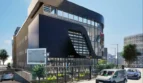
The New Administrative Capital keeps pulling in commercial investors, and Capital Hub Mall has positioned itself as a practical option in the R7 district. Developed by Al-Safwa Group (also known as SUD Development), this 30,000-square-meter project focuses on commercial stores, medical clinics, and administrative offices.
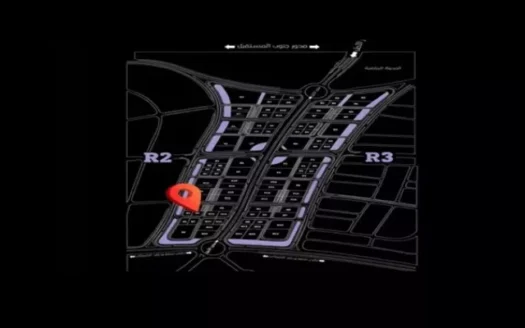
What makes Capital Hub worth a closer look isn’t the promotional language—it’s the location logic. The mall sits on the Central Axis parallel to Mohamed bin Zayed Southern Axis, next to the Diplomatic Quarter and close to the Green River, British University, and Expo City. For anyone evaluating commercial real estate in the capital, these aren’t just nice-to-have details. They’re access points that shape foot traffic, client reach, and whether your rental income will hold up over time.
I’ll walk through what Capital Hub Mall New Capital actually delivers: unit types and dimensions, how the payment structure works, location advantages compared to other districts, and what the developer’s history tells us about delivery and build quality. If you’re weighing commercial properties in the New Capital, the sections below provide the practical information you need to decide whether this project fits your investment criteria.
Capital Hub Mall New Capital Overview
Capital Hub Mall is a commercial and medical development by Al-Safwa for Urban Development, a company that’s been working in Egyptian real estate since 1996. Over more than 25 years, they’ve delivered residential compounds, commercial centers, and coastal projects—Capital Heights 1 and 2, Financial Hub, Hi City in Obour, and The Pearl in New Mansoura among others.
Their approach tends toward mixed-use developments with extended payment plans, which works for mid-tier investors who prefer installment flexibility over large upfront commitments. Capital Hub follows that pattern: zero down payment options and six-year installment plans.
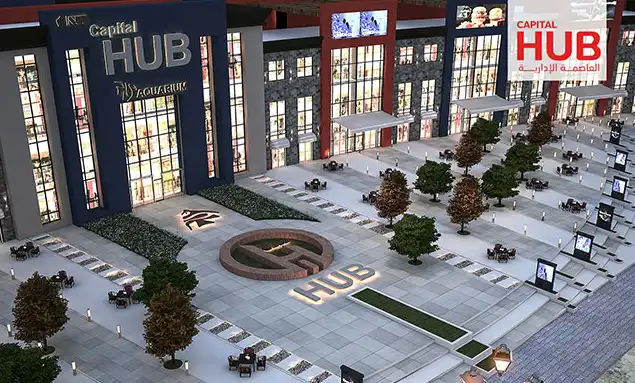
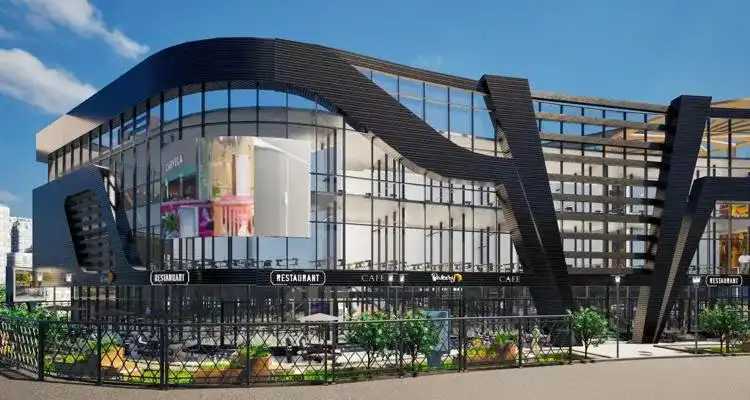
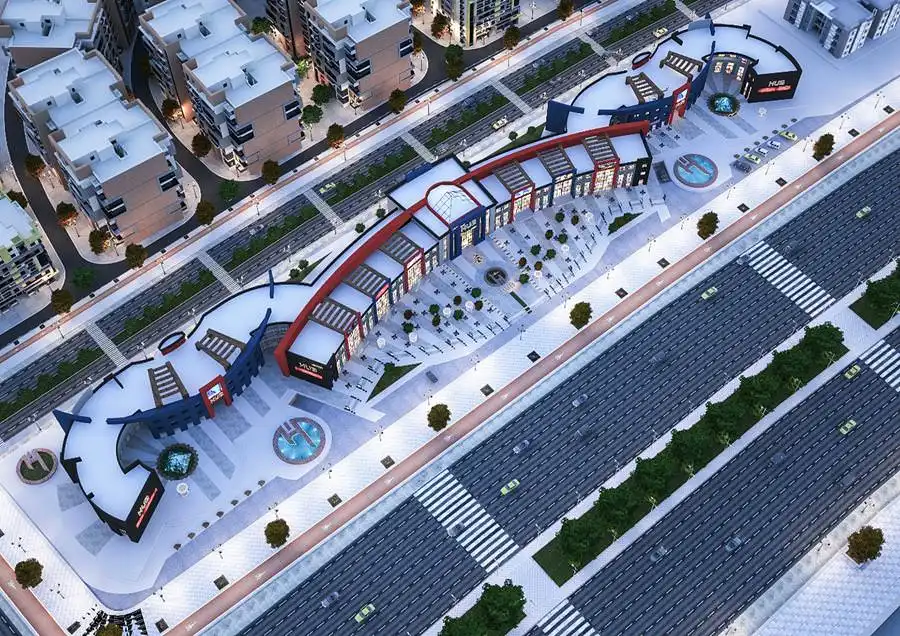
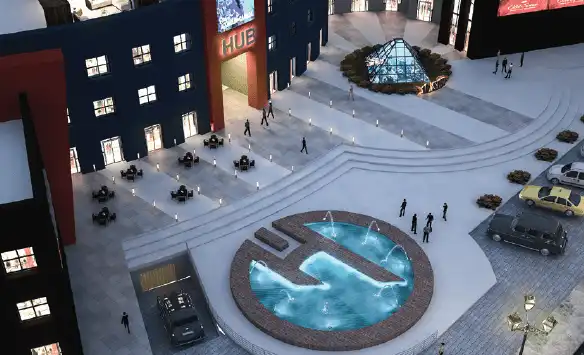
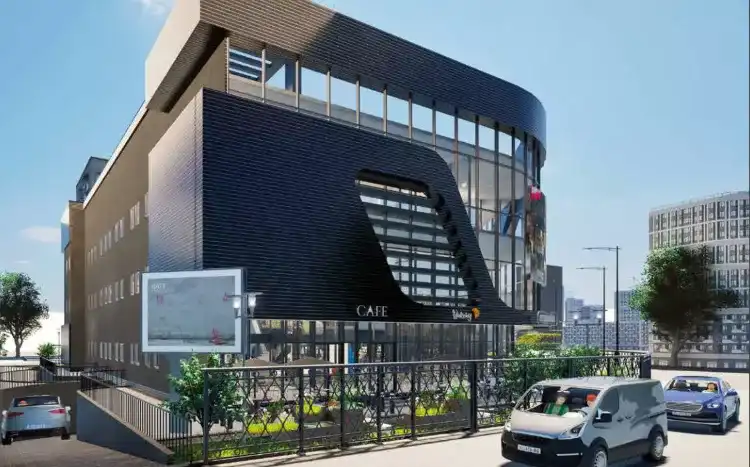
The mall itself runs across a ground floor, two upper levels, and a rooftop area. The design includes an aquarium feature on the facade—one of the first in the New Capital’s commercial scene—and the layout separates unit types by floor to cut down on congestion between commercial, medical, and administrative tenants.
Unit Types and Space Allocation
Capital Hub offers three main categories:
- Commercial units: 50 m² to 129 m²
- Medical clinics: 49 m² to 148 m²
- Administrative offices: Variable sizes starting from 50 m²
Each category in Capital Hub Mall New Capital targets different investor profiles. Smaller commercial units work for retail or service businesses. Larger medical spaces accommodate multi-room clinics or specialized practices. The size range gives you some flexibility, though it’s not as broad as what you’d find in larger mixed-use towers in the capital’s downtown core.
All units come with full finishing and air conditioning, which cuts down on post-purchase renovation costs—a practical point for investors who want to lease quickly after handover.
Capital Hub Mall New Capital Location Analysis
Location of Capital Hub Mall determines commercial viability more than almost anything else. Capital Hub sits in the R7 district, a zone that benefits from proximity to several anchor developments but stays outside the highest-priced downtown parcels.
The mall’s position on the Central Axis provides direct connectivity to:
- Green River Park: 5 minutes—this 35 km park is the capital’s central green corridor and a major pedestrian draw
- Diplomatic Quarter and Embassy District: 10 minutes—high-income residential zones with demand for premium services
- British University and Expo City: 5 minutes—institutional anchors that generate consistent traffic
- Downtown New Capital: 10 minutes—the administrative and governmental hub
- Cairo via Mohamed bin Zayed Axis: 30 minutes—reasonable commute for day visitors
This isn’t the most central location in the capital, but it’s well-positioned relative to residential clusters and institutional zones. The Diplomatic Quarter proximity matters particularly for medical and professional service tenants who depend on higher-income clientele.
Comparative Context
Compared to malls closer to the Governmental District or the landmark towers near the cathedral, Capital Hub Mall New Capital offers a trade-off: lower unit prices and less immediate density, but access to emerging residential neighborhoods that will mature over the next few years as embassy staff, university faculty, and government employees move in.
For investors with medium-term horizons, this positioning makes sense. For those wanting immediate foot traffic from day one, downtown parcels remain the safer—but pricier—choice.
Capital Hub Mall New Capital Amenities and Infrastructure
Al-Safwa has equipped the mall with a standard but functional amenity package:
- Parking: Multi-level underground garages—essential in a car-dependent city
- Security: Round-the-clock surveillance and on-site personnel
- Elevators and escalators: Multiple units to handle vertical traffic across three floors
- Fire safety systems: Alarms and extinguishers distributed throughout
- High-speed internet: Fiber infrastructure for all units
- Central air conditioning: Included in all spaces
- Signage and wayfinding: Digital screens and directional markers
The rooftop level includes open spaces with views of surrounding green areas and water features in the central courtyard. It’s designed as a mixed-use zone—cafes, possibly event space—but specific tenant plans weren’t disclosed in available materials.
Service Clusters Within Mall Capital Hub New Capital
Capital Hub New Capital Mall includes:
- Restaurants and cafes (brands not yet finalized)
- Retail stores for apparel, goods, and consumer products
- Pharmacies operating around the clock
- Fitness gym with modern equipment
- Spa and wellness centers
- Children’s play area with secured access
These aren’t groundbreaking features, but they’re necessary for a mall aiming to function as a neighborhood hub rather than just a transit stop. The mix supports longer dwell times, which benefits surrounding commercial tenants.
Unit Pricing and Payment Plans
Pricing at Capital Hub Mall starts at approximately EGP 5,888,000, with variation based on unit type, size, and floor.
Pricing Breakdown by Unit Type
- Commercial stores: EGP 2,240,000 to EGP 12,652,000
- Medical clinics: EGP 1,888,000 to EGP 4,752,000
Smaller medical units in the 50–70 m² range fall on the lower end. Larger commercial spaces with street-level access command premium pricing.
Payment Structure
Al-Safwa offers two main payment schemes:
- 10% booking deposit, with the remainder paid in equal installments over 6 years, interest-free
- 10% maintenance deposit due upon delivery
This structure reduces initial capital requirements, which works for small business owners, solo practitioners, and investors building portfolios step by step. The zero-interest component stands out in a market where financing costs can erode returns.
Practical Considerations and Potential Drawbacks
No project comes without trade-offs. Capital Hub Mall New Capital presents a few considerations worth noting.
Unit Diversity and Privacy
The mix of commercial, medical, and administrative tenants on shared floors could reduce privacy for medical practices that require discretion. Al-Safwa has addressed this by distributing unit types across different levels and providing separate entrances where feasible, but it’s not a fully segregated layout.
Medical investors should assess whether the floor plan supports patient confidentiality and whether adjacency to retail tenants affects the professional atmosphere.
Market Maturity
The R7 district is still developing. While anchor institutions are in place, residential occupancy rates remain below mature neighborhoods. This means:
- Foot traffic will grow gradually rather than immediately
- Rental yields may take 2–3 years to stabilize
- Early tenants bear higher marketing costs to build awareness
Investors with short-term liquidity needs or those expecting immediate returns should weigh this carefully.
Who Capital Hub Mall New Capital Suits?
Capital Hub Mall New Capital fits specific investor profiles:
- Small business owners seeking affordable commercial space with flexible payment terms
- Medical practitioners looking for clinic space in a growing district near high-income residential areas
- Portfolio investors building exposure to the New Capital without committing to premium-priced downtown units
- Rental income seekers with a 3–5 year investment horizon who can wait for the district to mature
Capital Hub Mall is less suited for:
- Investors needing immediate rental income from day one
- Businesses requiring ultra-premium branding or flagship locations
- Those with very short-term exit strategies
Comparing Capital Hub to Nearby Commercial Projects
Several malls operate near Capital Hub Mall. Understanding the competitive landscape helps clarify positioning:
- Pioneer Plaza Mall: Focuses on fresh food and health-oriented retail—different tenant mix, less direct competition
- Zaha Park Mall: Larger scale, more upscale branding, higher unit prices
- Elite Mall: Similar positioning but slightly closer to the Government District
- Smart Mall: Family-oriented, entertainment-heavy—complements rather than competes
Capital Hub sits in the middle tier: more accessible than Zaha Park, more business-focused than Smart Mall, and better connected than Pioneer Plaza. It’s not the cheapest option, nor the most expensive—it occupies a practical middle ground for investors balancing cost and location.
Frequently Asked Questions
What is the exact location of Capital Hub Mall in the New Capital?
Capital Hub Mall is located in the R7 district of the New Administrative Capital, on the Central Axis parallel to Mohamed bin Zayed Southern Axis. It sits adjacent to the Diplomatic Quarter and within 5 minutes of the Green River, British University, and Expo City. The location provides access to emerging residential zones and institutional anchors, with a 30-minute drive to central Cairo. This positioning balances accessibility with lower unit pricing compared to downtown parcels.
Can I purchase a unit with zero down payment?
Yes, Al-Safwa offers a payment plan that requires only a 10% booking deposit, with the remaining balance divided into equal installments over 6 years without interest. A separate 10% maintenance deposit is due upon delivery. This structure reduces upfront capital requirements and is designed for small business owners, medical practitioners, and incremental investors. Verify current terms directly with the developer, as payment structures can be updated.
What are the typical unit sizes for medical clinics?
Medical clinics at Capital Hub Mall range from 49 m² to 148 m². Smaller units (49–70 m²) suit solo practitioners or specialized consultation services. Mid-sized clinics (80–100 m²) accommodate multi-room setups with waiting areas. Larger spaces (120–148 m²) support group practices or diagnostic centers. All units are delivered fully finished with central air conditioning, reducing setup time and renovation costs for medical tenants.
How does Capital Hub compare to other malls in the R7 district?
Capital Hub occupies a mid-tier position. It’s more affordable than premium developments like Zaha Park Mall, which targets higher-end retail and wealthier tenants. It’s more business-focused than family entertainment centers like Smart Mall. Compared to Elite Mall, Capital Hub offers slightly lower prices but similar access to the Diplomatic Quarter. The trade-off is between immediate prestige and long-term value as the district matures.
What is Al-Safwa’s track record with project delivery?
Al-Safwa for Urban Development has been active since 1996 and has completed projects including Capital Heights 1 and 2, Financial Hub, Hi City in Obour City, and The Pearl in New Mansoura. They focus on mid-tier residential and commercial developments with extended payment plans. While they’ve delivered multiple projects, they’re not among the largest-scale developers in Egypt. Prospective buyers should request updated handover timelines and visit completed projects to assess quality firsthand.
Conclusion
Capital Hub Mall New Capital presents a practical commercial investment opportunity for those willing to take a medium-term view. The location in R7 offers access to the Diplomatic Quarter, Green River, and institutional anchors without the premium pricing of downtown parcels. Unit sizes accommodate a range of business types, and the payment structure—10% down, six years interest-free—reduces upfront capital barriers.
Capital Hub Mall New Capital suits small business owners, medical practitioners, and portfolio investors building exposure to the New Capital incrementally. It’s less ideal for those needing immediate returns or flagship locations with established foot traffic from day one. Al-Safwa’s track record shows consistency in mid-tier developments, though they lack the scale of Egypt’s largest developers.
If you’re comparing commercial properties in the New Capital, Capital Hub deserves consideration—not for what it promises, but for what it offers: reasonable pricing, strategic positioning, and flexibility that aligns with investors who understand that value in emerging districts requires patience and timing.
Similar Listings
EVOLVE Tower New Capital | Commercial In...
Radical 1 Mall New Capital | Commercial ...
Ellite Mall New Capital Prices 2026