

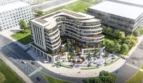
Description
The New Administrative Capital continues to take shape east of Cairo, and Promark Mall positions itself in what’s intended to become the financial heart of this new city. Developed by MG Developments, the project sits between the government quarter and the banking district—close to the Egyptian Stock Exchange and several major financial institutions.
This is a commercial-administrative development spanning 8,836 square meters. It’s not trying to be a regional shopping destination. The focus is straightforward: office space and retail units serving the immediate business district.
For anyone considering a unit in Promark Mall New Capital wether for their own business or as an investment—the location matters more than the building itself. You’re betting on the New Capital’s continued development, the migration of businesses from old Cairo, and the completion of promised infrastructure. The project has practical advantages, but it also carries the uncertainties typical of any emerging district.
Promark Mall New Capital Location
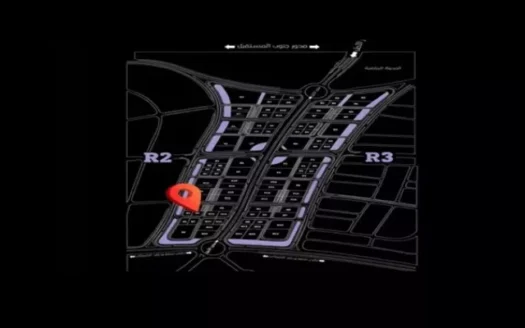
Promark Mall New Capital sits in the Downtown area of the New Administrative Capital, specifically positioned between two key zones: the financial district to one side and the government quarter to the other. The Egyptian Stock Exchange is roughly two minutes away by car.
Several banks have established branches nearby. You’ll find the National Bank of Egypt, Commercial International Bank, Bank Audi, Arab African International Bank, and Banque Misr all within walking distance. For businesses that need regular access to banking services or frequently meet with financial sector clients, this clustering reduces daily logistics.
Mall Promark New Capital faces Central Park, one of the planned green spaces meant to soften the New Capital’s otherwise hard urban landscape. Nearby, you’ll find the Capital Library and a planned cinema complex, though these serve more as landmarks than daily amenities for business tenants.
Current access relies on the Regional Ring Road and Cairo-Suez Road. The Mohamed bin Zayed North Axis provides another route. The monorail station and metro stops are planned for the area, but they’re still under construction. Once operational, they should improve connectivity significantly—but that’s a future benefit, not a current one.
Business Park towers, Diamond Tower, and OIA Towers are close enough for inter-company meetings without much travel time. This concentration of commercial projects is either a strength (critical mass of business activity) or a concern (oversupply of similar units), depending on how quickly tenant demand materializes.
What You’re Actually Getting?
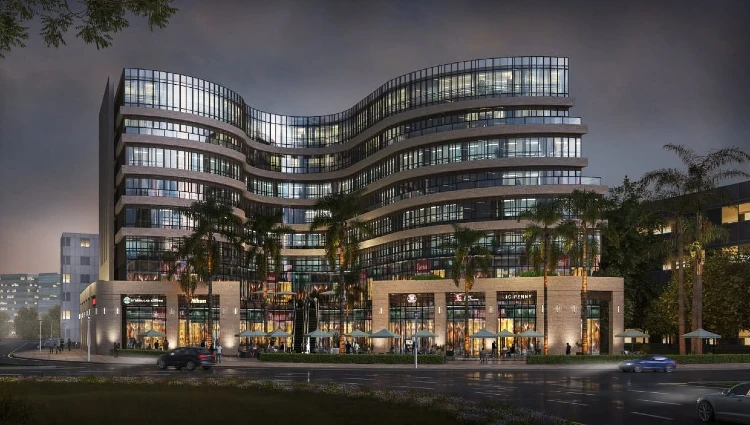
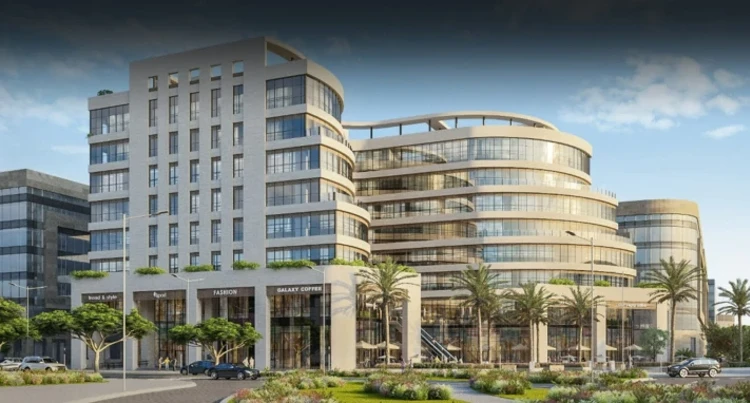
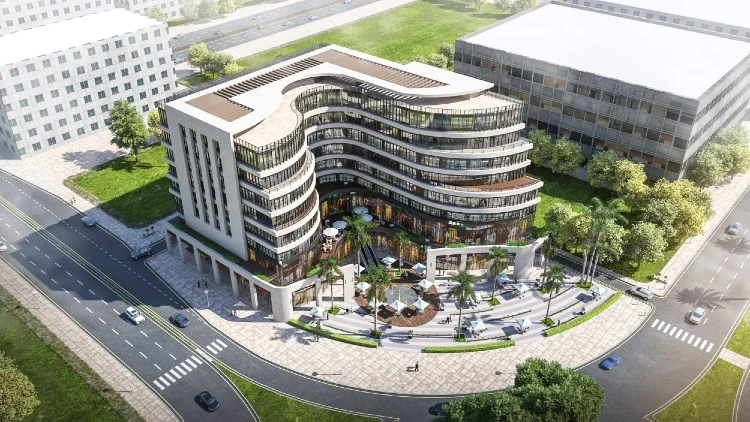
Promark Mall New Capital dedicates two basement levels to parking, two floors to commercial retail, and six floors to administrative offices. It’s a straightforward commercial structure—no residential component, no hotel, no entertainment complex.
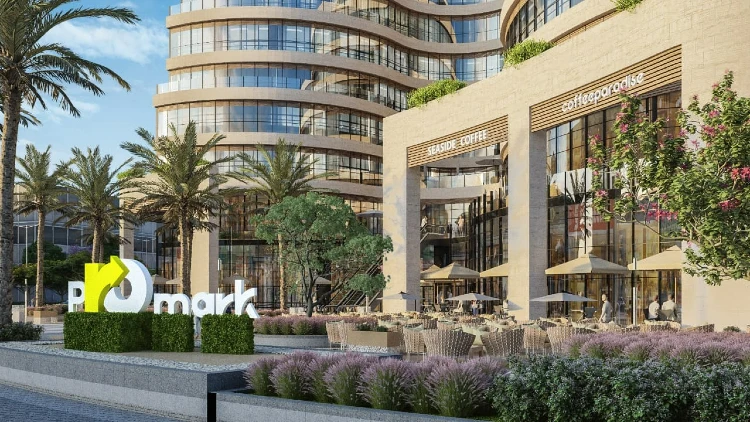
Commercial units start at 30 square meters with 5.40-meter ceilings. These ground and first-floor spaces suit retail shops, cafes, or service businesses that benefit from street visibility. The glass facades allow natural light and provide window display opportunities for retail tenants.
Administrative offices in Promark Mall also begin at 30 square meters, with 3.60-meter ceilings across the upper six floors. These work for consultancies, small agencies, accounting practices, legal offices, or satellite locations for larger firms. Some units include outdoor terraces, though which ones isn’t specified in available materials.
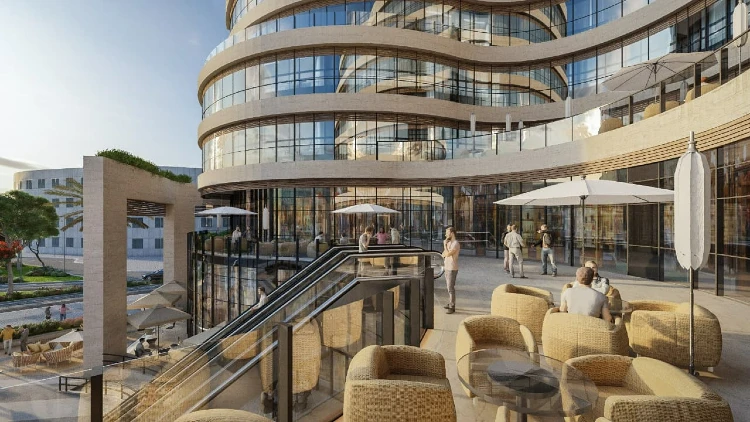
The exterior combines glass and marble—the standard aesthetic for New Capital commercial buildings. It looks professional and modern without breaking any architectural ground. Five elevators serve the building, plus two escalators and a dedicated freight elevator for retail deliveries. There’s also an accessible elevator for people with mobility limitations.
Mall Promark systems are adequate. Central air conditioning throughout, though that means you don’t control your own unit’s temperature. Fiber optic internet infrastructure. Standard security with cameras and personnel. Two conference rooms and VIP lounges available for tenant use.
Solar panels provide supplemental power. There’s a waste management system. Designated smoking areas keep common spaces smoke-free. Maintenance teams handle building upkeep, covered through your maintenance fees.
Nothing here is particularly innovative, but nothing seems obviously deficient either. It’s a functional commercial building designed to meet basic business needs.
Promark Mall New Capital Pricing and Payment Plans
MG Developments prices administrative and commercial units differently, reflecting their different uses and locations within the building.
Administrative offices start around 45,000 EGP per square meter. Commercial retail units start around 150,000 EGP per square meter. These are starting points—actual prices vary by floor, size, corner positioning, and whether you get a terrace.
You’ll also pay a 10% maintenance deposit at purchase in Promark Mall. Ongoing maintenance fees aren’t clearly specified in available information, which is something to clarify before signing anything.
Three payment plans are offered:
- Five-year plan: No down payment required. Equal installments over 60 months.
- Six-year plan: 10% down payment at contract signing. Remainder in equal installments over 72 months.
- Nine-year plan: 30% down payment, then 10% after one year. Remainder spread over nine years in equal installments.
The extended payment terms reduce upfront capital requirements. For small businesses or investors buying multiple units, this matters. However, the available information doesn’t clarify whether these plans include interest or administrative fees. The total amount you’ll actually pay versus the stated unit price needs verification.
The no-down-payment option sounds attractive but likely comes with trade-offs—possibly in total cost, possibly in unit selection, possibly in both. Get the full numbers before deciding which structure makes sense for your situation.
MG Developments: What They’ve Done Before
MG Developments (sometimes referenced as MG Investment or Mutawa Group) was established in 1998. They’ve worked across residential, commercial, and resort properties in Egypt.
Their portfolio includes La Vida in Heliopolis, Sky View in the Fifth Settlement, Premium Business in New Cairo, and Blue Blue resort in Ain Sokhna. This shows experience across different property types and locations—established Cairo neighborhoods, New Cairo extensions, and Red Sea resort areas.
Promark Mall represents their first significant project in the New Administrative Capital. That’s worth noting. The New Capital operates under different dynamics than mature neighborhoods. Success here depends on government commitment, infrastructure completion, and actual business migration from old Cairo. Previous experience in Heliopolis or New Cairo doesn’t automatically translate to navigating these specific variables.
Track record matters, but each project carries its own execution risks. If you’re considering a purchase, verify completion timelines on their past projects and check whether they maintain quality in post-sale management and building operations.
Promark Mall New Capital Services and Amenities
- Security in Promark Mall coverage includes cameras throughout common areas and dedicated personnel operating 24/7. This provides baseline protection, though individual unit security remains each tenant’s responsibility.
- Climate control uses a central air conditioning system rather than unit-specific systems. This maintains consistent building temperatures but limits your control over your specific space. The building’s eastern orientation supposedly provides natural ventilation, though relying on this for cooling in Egyptian summers seems optimistic.
- In Promark Mall New Capital Parking spans two basement levels, designed to handle tenant and visitor vehicles. Whether this proves sufficient depends on the final tenant mix and traffic patterns. Retail businesses generating high customer turnover might face challenges if office tenants occupy spaces during business hours.
- The two conference rooms and VIP lounges come equipped with audio-visual technology. For smaller operations, these shared spaces eliminate the need to maintain dedicated conference rooms within your own unit—a practical cost-saver.
- There is High-speed internet infrastructure in Mall Promark New Capital runs throughout the building, with fiber connections available to individual units. This is a baseline requirement for modern business, not a luxury feature.
- Accessible bathrooms on each floor. Designated smoking areas. A maintenance team handling common area upkeep and building system issues, paid through your maintenance fees.
- The amenities are standard for a commercial building. Nothing exceptional, nothing obviously missing.
How Promark Mall Compares to Other New Capital Projects?
Several commercial developments compete for tenants and investors in the New Capital.
Paragon Mall 2 operates at larger scale with emphasis on international retail brands, targeting a more regional shopping audience. Promark Mall focuses on serving the immediate financial district rather than drawing from across the capital.
Senet Mall 3 includes entertainment components—cinemas and family entertainment centers—alongside retail and dining. Promark Mall prioritizes business functions over entertainment, making it more suitable for professional services than family-oriented retail.
Mastro Mall positions similarly to Promark Mall: commercial and administrative spaces targeting business tenants in the financial district. Direct comparison of pricing, payment terms, and exact locations would determine which offers better value for specific business types.
Monorail Tower Mall leverages its connection to the planned monorail station, betting on future transport access as a differentiator. Promark’s proximity to the Stock Exchange and banking cluster provides advantages now, while transport-dependent projects carry timing risk if infrastructure completion delays.
Promark’s competitive position rests on immediate financial district location and flexible payment terms rather than unique architecture or anchor tenants. For businesses prioritizing proximity to banks and government offices, this focus may align well.
The New Capital Reality Check
Investing in Promark Mall means investing in the broader New Administrative Capital vision. That requires honest assessment.
The New Capital represents Egypt’s most ambitious urban project—relocating government operations, attracting businesses, creating a modern city from undeveloped land. Full success creates substantial real estate value. Partial success or delayed timelines produce more mixed results.
For Promark Mall New Capital specifically:
- Upside potential exists if the financial district fully develops, government operations concentrate nearby, and transport links complete on schedule. The mall would then sit at the center of significant daily business activity.
- Downside risks include slower government migration, delayed infrastructure, or insufficient residential density to support retail tenants. Administrative office tenants might find adequate clients, but retail businesses depend on population density and disposable income nearby.
- Timeline expectations should be realistic. The New Capital is a multi-decade project. Early investors accept higher uncertainty in exchange for better pricing and unit selection. If you need immediate returns or established customer bases, the market might be premature for your needs.
Compare Promark’s pricing to similar spaces in established Cairo commercial districts. If New Capital units cost 60-70% of equivalent New Cairo spaces but carry more uncertainty, does the discount compensate for risk? That depends on your specific circumstances and risk tolerance.
Who This Actually Fits?
Promark Mall Financial services and consulting firms benefit most directly. Proximity to banks, the Stock Exchange, and government offices reduces client meeting logistics. Accounting practices, legal consultancies, and financial advisors serving corporate clients would find the address professionally appropriate.
Small to mid-sized businesses seeking professional office space at lower cost than mature Cairo districts represent another logical fit. The unit sizes and pricing accommodate operations with 3-15 employees, providing legitimate business addresses without premium-district costs.
Investors with medium-term horizons (5-10 years) who can absorb potential rental income delays or slower appreciation might find the risk-reward ratio acceptable. The extended payment terms allow leveraging capital across multiple investments rather than concentrating funds in single properties.
Retail concepts targeting business clientele—lunch spots, coffee shops, business services like printing or courier, professional attire retailers—have better chances than businesses requiring high residential foot traffic. The customer base will be office workers and government employees rather than families or evening shoppers.
Businesses requiring immediate high traffic or established customer bases. Retail concepts depending on evening or weekend shopping (this will be a business-hours district). Investors needing short-term liquidity or quick returns. Operations requiring specific infrastructure not yet completed.
Frequently Asked Questions
When will the monorail and metro actually open?
Official projections of Promark Mall suggest phased openings through 2024-2025, but infrastructure projects of this scale often face delays. Plan based on current vehicle access rather than projected future transport. Treat the eventual metro and monorail as upside, not guaranteed timeline elements.
What happens if I need to sell before completing payments?
You’ll typically need to either pay off the remaining balance or find a buyer willing to assume the payment plan (subject to developer approval). The resale market in the New Capital remains relatively new and less liquid than established Cairo areas. Factor in potential holding periods of 3-5 years minimum before assuming easy resale.
Are there restrictions on business types?
Commercial developments typically maintain tenant mix standards to preserve property values. While specific restrictions weren’t detailed in available materials, malls generally prohibit heavy manufacturing, hazardous materials, or operations creating excessive noise. Medical clinics, professional services, retail shops, cafes, and standard offices typically receive approval. Verify compatibility with MG Developments before purchasing if you’re planning a specific business type.
How do maintenance fees actually work?
Promark Mall requires a 10% maintenance deposit at purchase, but ongoing monthly or annual fees aren’t clearly specified. Typically, commercial buildings charge maintenance fees covering common area cleaning, security, elevator maintenance, and building system upkeep. These usually range from 10-20 EGP per square meter monthly in similar projects. Request detailed fee schedules before committing.
Can foreign investors purchase units?
Egypt generally allows foreign ownership of commercial properties, though specific regulations and approval processes apply. Foreign buyers need Egyptian real estate attorneys to navigate ownership registration, tax obligations, and sector-specific restrictions.
Currency exchange considerations also affect foreign investors—purchase prices are in Egyptian pounds, creating currency risk over extended payment plans if the pound depreciates. Consult with legal and tax professionals familiar with Egyptian commercial property law.
What rental yields are realistic?
Rental yield projections for New Capital properties remain speculative given the market’s early stage. Established Cairo commercial properties generate 6-10% annually depending on location and type. New Capital properties might eventually reach similar yields but currently face limited tenant demand, uncertain market rents, and potential vacancy periods.
Conservative investors should model scenarios assuming 2-3 years of low occupancy or below-market rents while the area develops. The investment case relies more on long-term capital appreciation as the New Capital matures than on immediate rental income.
Conclusion
Promark Mall New Capital offers a practical entry point into Egypt’s most significant urban development project. The location between financial and government districts provides proximity advantages for specific business types. The flexible payment terms reduce upfront capital requirements.
The project suits businesses needing professional addresses near banking and government institutions, and investors with medium-term horizons who can navigate the New Capital’s development timeline. The pricing sits below premium developments while maintaining reasonable specifications.
This remains an early-stage market with infrastructure still under construction and tenant demand yet to fully materialize. Success depends less on the mall’s specific features and more on the broader New Capital’s evolution over the next decade.
If you’re evaluating Promark Mall, base your decision on realistic assessment of the location’s development trajectory, honest evaluation of your timeline flexibility, and clear understanding of how this investment fits within your broader strategy. The opportunity exists, but so do the uncertainties typical of emerging districts.
Similar Listings
EVOLVE Tower New Capital | Commercial In...

Spinner Mall New Capital | What You Shou...
Ellite Mall New Capital Prices 2026