Description
The New Administrative Capital keeps adding commercial projects, but not all of them follow the same template. Dahab Mall New Capital takes a more focused route—it’s built specifically for gold and jewelry businesses rather than trying to be everything to everyone.
UC Developments put this project in MU-23, a commercial zone that’s gaining some momentum because the infrastructure around it is actually finished. The mall sits on about 8,300 square meters with a ground floor and eight levels above it. Commercial units take up the lower floors, administrative spaces sit higher up.
If you’re looking at specialized retail or service space in the capital, this guide walks through what Dahab Mall offers and where it fits in the broader commercial landscape. No hype, just the practical details on location, unit types, costs, and how it compares to other options in the area.
Where Dahab Mall Sits and How You Get There?
Dahab Mall New Capital is located in MU-23 , it isn’t the flashiest address in the New Capital, but it has some things going for it. You’re about five minutes from Suez Road, which is the main artery connecting the capital to Cairo and points beyond. For a business that needs customers coming from different directions, that access matters.
The Embassies and Ministries District is close enough to matter—government employees and diplomatic staff represent a customer base with actual purchasing power for gold and jewelry. The Iconic Tower is roughly ten minutes away. The project looks out over Green River Park, which tells you the area is part of the capital’s developed sections rather than the outer edges still waiting for basic infrastructure.
Al-Fattah Al-Aleem Mosque serves as a landmark people can navigate by. The broader commercial zone connects to Mohamed Bin Zayed Axis and Al-Amal Axis, so the area was planned with accessibility in mind rather than being an afterthought.
Here’s what this location gives you: highway access that works, proximity to completed government buildings, and a spot within a commercial district that’s actually functioning. What you don’t get: the foot traffic of older Cairo neighborhoods or the immediate visibility of projects right on the CBD’s main strip.
How Dahab Mall New Capital is Laid Out?
The 8,300 square meters breaks down to roughly 30% buildings and units, with 70% going to green spaces, walkways, and parking. That ratio is fairly standard for commercial projects here—space isn’t as tight as it is in Cairo proper.
Nine total levels: ground floor plus eight above. Ground through fourth floors hold commercial units—your gold shops, jewelry retailers, related businesses. Floors five through eight are administrative units, which could work for jewelry companies, import/export operations, or service businesses that benefit from being in a specialized commercial center.
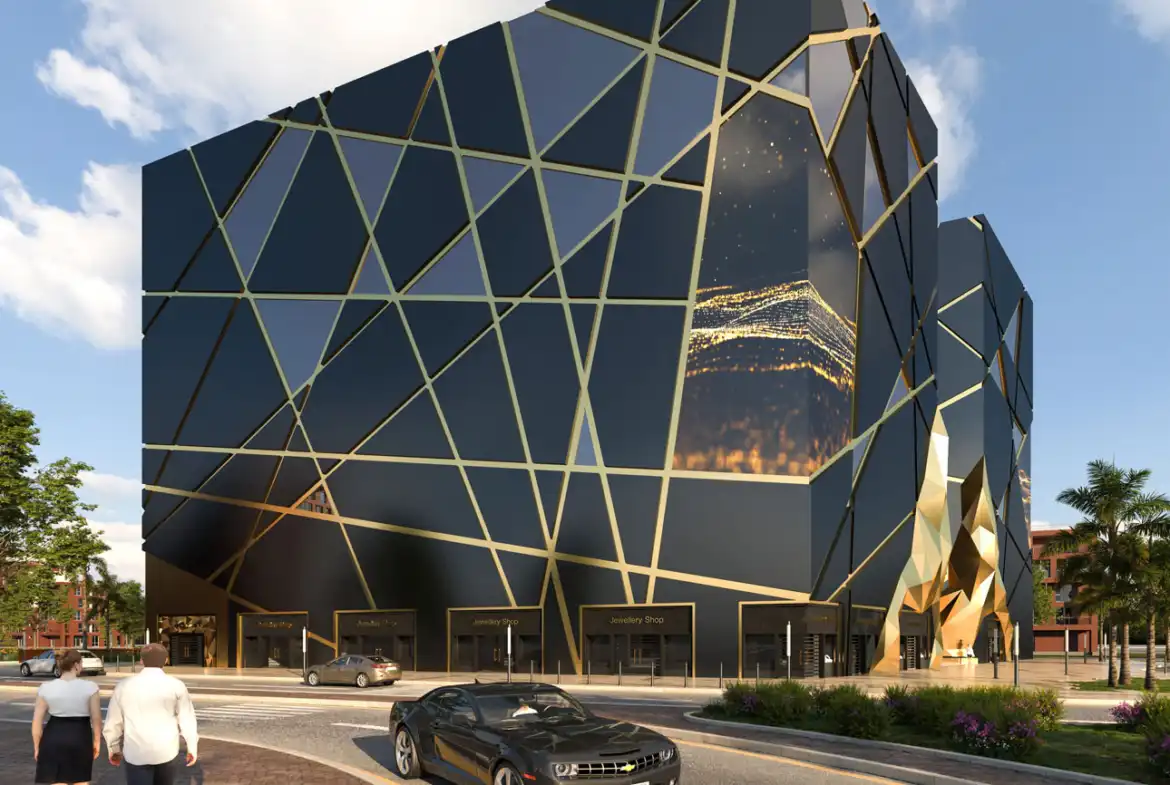
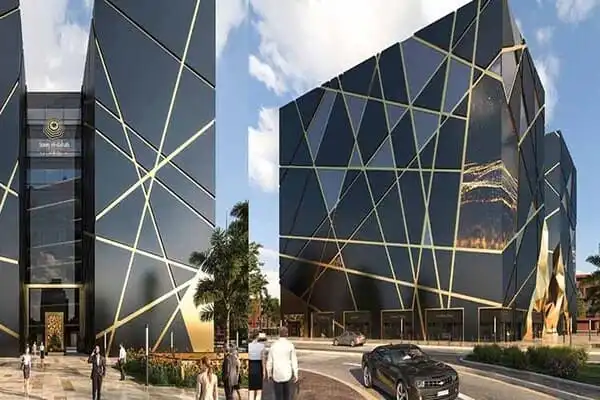
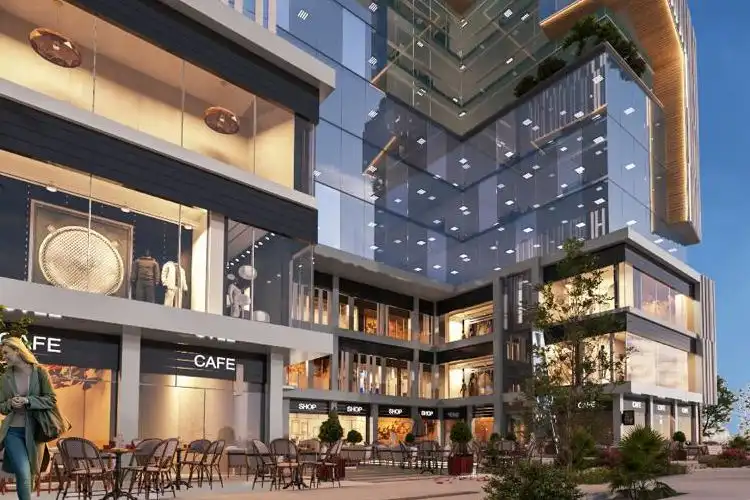
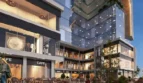
The developer talks about “European-inspired” architecture and 3D golden facades. The practical takeaway is the building is designed to be visually distinct and aligned with the gold theme, which might help with brand recognition.
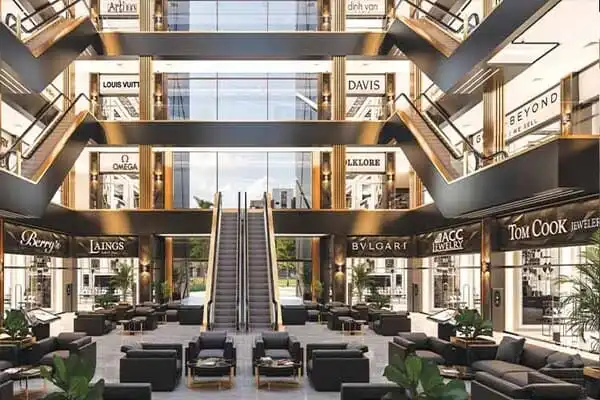
Elevators and escalators handle vertical movement in Dahab Mall. Surveillance systems and electronic security gates are installed throughout. Ground floor gets the most foot traffic, making those units more valuable for retail that depends on walk-ins.
Glass facades bring in natural light and give ground-level shops visibility, which matters for jewelry retail where product display is part of the selling process. Upper commercial floors won’t have the same passive visibility—you’ll need to market more actively.
What Unit Sizes Are Available
Dahab Mall offers two main categories: commercial and administrative. Understanding the size ranges helps you figure out what type of operation each can actually handle.
Commercial Units:
- 49 to 143 square meters
- Ground floor through fourth floor
- Retail shops, jewelry stores, gold dealers
A 49-square-meter unit in Dahab Mall gives you enough space for a focused retail operation—display cases, small back office, customer service area. Works for independent jewelers or specialized dealers who don’t need extensive inventory display space.
Units in the 80 to 100 square meter range can handle more elaborate showroom layouts with separate consultation areas, which higher-end jewelry retailers often want.
The 143-square-meter units approach small boutique scale, suitable for established brands or dealers who want to offer a broader product range with dedicated sections.
Administrative Units:
- 26 to 72 square meters
- Fifth through eighth floors
- Offices, company headquarters, service businesses
Smaller administrative units in Dahab Mall (26 to 40 square meters) work for single-person operations, satellite offices, or businesses that operate primarily online but need a registered capital address.
Mid-range units (40 to 60 square meters) can house small teams—useful for jewelry import companies, gemstone dealers, or business services targeting the gold trade.
The 72-square-meter spaces allow for proper office layouts with separate meeting rooms, which matters if you host client consultations or vendor meetings regularly.
One thing to keep in mind: commercial units on lower floors will likely appreciate faster than administrative spaces on upper floors. Retail visibility drives value more directly than office location in these developments.
What Services and Infrastructure Are Actually There?
Dahab Mall New Capital includes standard commercial building services. Worth distinguishing between what’s genuinely useful and what’s just marketing language.
Security and Monitoring:
- 24-hour security personnel
- Surveillance camera coverage
- Electronic security gates at entrances
For a gold and jewelry center in Dahab Mall, security isn’t optional—it’s fundamental. The presence of trained security staff and comprehensive camera systems addresses the primary concern when you’re dealing with high-value inventory. Electronic gates add access control that helps manage who enters the building.
Building Systems:
- Central air conditioning throughout
- Backup generators for power continuity
- Fire suppression systems
- Elevators and escalators
These are baseline requirements for any modern commercial building in the capital. Backup generators matter particularly if you have electronic security systems or climate-controlled inventory storage.
Operational Services:
- Regular maintenance and cleaning
- Parking garages with capacity for multiple vehicles
- Cafes and coffee shops (planned or in development)
Parking capacity in Dahab Mall is more important than it might seem at first. Customers buying gold and jewelry often prefer driving directly to the location rather than using public transport, especially when carrying valuable items. Adequate parking reduces friction in the customer experience.
Maintenance and cleaning services are typically contracted to third-party providers, with costs often passed through to unit owners via service charges. This is standard practice, but confirm the annual service charge rate before you buy—it affects your operating costs.
What Units Actually Cost?
Pricing at Dahab Mall New Capital starts at approximately 126,000 Egyptian pounds per square meter. That’s the baseline rate—actual prices vary based on floor level, unit size, and position within the building.
Sample Pricing Calculations:
- 49 sqm commercial unit: ~6,174,000 EGP (at base rate)
- 80 sqm commercial unit: ~10,080,000 EGP
- 143 sqm commercial unit: ~18,018,000 EGP
- 26 sqm administrative unit: ~3,276,000 EGP
- 72 sqm administrative unit: ~9,072,000 EGP
These use the starting price per square meter. Ground floor units and corner positions typically command premiums of 15-30% above the base rate. Upper floor administrative units may be priced slightly below it.
Payment Plan Structure:
The developer of Dahab Mall New Capital offers a 15% down payment with the remaining balance spread over six years. Here’s what that means practically:
For a 6,174,000 EGP unit (49 sqm):
- Down payment: 926,100 EGP
- Remaining balance: 5,247,900 EGP
- Monthly installment over 72 months: ~72,888 EGP
This payment structure in Mall Dahab New Capital is more accessible than full cash payment, but compare it to bank financing options. Banks might offer longer terms at competitive rates depending on your financial profile.
No interest is explicitly mentioned in the installment plan, which is standard phrasing in Egypt. However, the per-square-meter price for installment buyers versus cash buyers sometimes differs, effectively building financing costs into the unit price.
Delivery and Finishing:
Units are delivered with basic finishing—typically means flooring, painted walls, bathroom fixtures, and electrical/plumbing rough-ins. Specialized retail fit-out (display cases, lighting, security systems specific to jewelry retail) is your responsibility and should be budgeted separately.
For a jewelry shop, expect to invest an additional 1,500 to 2,500 EGP per square meter for proper retail finishing, depending on your brand positioning and design requirements.
Investment Considerations Worth Thinking Through
Evaluating Dahab Mall as an investment requires looking beyond the promotional materials and considering practical market factors.
Demand Side
The New Administrative Capital’s gold and jewelry market is still developing. Unlike established areas like Khan el-Khalili or Muski in Cairo, which have decades of customer loyalty and foot traffic, the capital’s commercial centers are building their customer bases from scratch.
The potential customer base includes government employees (stable demographic with regular income), diplomatic personnel (who may have different purchasing patterns than local customers), and residents of the capital’s residential compounds (growing but still limited population).
Concentrating gold and jewelry businesses in one location can work two ways: it may create a destination shopping effect where customers visit specifically to compare options, or it may lead to intense price competition that compresses margins.
Supply Side
Several commercial malls in the New Capital offer retail space suitable for jewelry businesses—ITC Mall (also developed by a company using the Dahab name, which creates some market confusion), Soul Plaza, and sections of the Downtown area. Dahab Mall faces competition for both tenants and customers.
The specialized positioning as a gold and jewelry center is a differentiator, but it also creates dependency on a single sector. If gold prices fluctuate significantly or import regulations change, the entire project’s tenant base faces the same pressures simultaneously.
Returns and Exit Strategy
Rental yields in the New Capital’s commercial projects typically range from 6% to 9% annually, though this varies significantly based on location, tenant quality, and lease terms. Ground floor retail in active areas performs better than upper floor administrative space.
For Dahab Mall specifically, rental potential depends heavily on the project’s success in establishing itself as a recognized gold shopping destination. First movers may secure tenants at lower rates to fill the space, while later units could command premiums if the center gains traction.
Resale liquidity in the capital’s commercial market is lower than in established Cairo neighborhoods. Plan for a longer hold period (5+ years) to see meaningful appreciation and allow the area to mature.
Who This Suits?
Dahab Mall makes sense for:
- Established gold or jewelry dealers looking to expand into the capital
- Investors with industry connections who can secure reliable tenants
- Businesses that specifically need to be near government districts
- Buyers who believe in the capital’s long-term commercial development and can hold through the maturation period
It’s less suitable for:
- First-time commercial investors without industry knowledge
- Those expecting immediate rental income at high yields
- Businesses dependent on heavy foot traffic from day one
- Investors seeking quick resale liquidity
How Dahab Mall Compares to Similar Projects?
Understanding where Dahab Mall fits in the broader commercial landscape helps set realistic expectations.
ITC Mall (also associated with Dahab/IC Group)
ITC Mall sits at the intersection of Al-Amal Axis and Mohamed Bin Zayed Axis, also in a commercial zone of the capital. It offers commercial, administrative, and medical units with a similar price range. The key difference is ITC’s mixed-use approach versus Dahab Mall’s specialized gold and jewelry focus.
For investors, ITC’s diversification across sectors may reduce risk, while Dahab Mall’s specialization could create stronger destination appeal if successfully marketed.
Soul Plaza and Vivid Tower
These are more established commercial centers in the capital with broader retail mixes and higher foot traffic due to their proximity to completed residential areas. They command higher per-square-meter prices (often 150,000 to 200,000 EGP) but offer more immediate tenant demand and rental income potential.
Dahab Mall’s lower entry price reflects its specialized nature and the need to build market recognition.
Downtown Commercial District
The capital’s Downtown area represents the premium commercial location, with prices significantly above Dahab Mall’s range. Projects there benefit from government-backed development and planned high-density residential and office towers.
Dahab Mall offers a more accessible entry point but without the same infrastructure certainty or foot traffic guarantees.
Practical Comparison Points
- Price per sqm: Dahab Mall is competitively priced for its location
- Specialization: Unique in its gold/jewelry focus, which is both advantage and risk
- Developer track record: UC Developments has less market presence than larger developers, which affects buyer confidence
- Location maturity: MU-23 is developing but not yet fully active commercially
Developer Background: UC Developments
UC Developments (also referenced as IC Group in some materials) is the company behind Dahab Mall. Unlike major Egyptian developers with decades of history and multiple landmark projects, UC Developments has a shorter public track record in the New Capital market.
The company’s previous work includes:
- Easy Life Project in New Cairo
- Smart Life New Cairo
- Life Mall in Fifth Settlement
- The Office Mall New Capital
- Life View Project Fifth Settlement
These projects are primarily in New Cairo’s Fifth Settlement, which gives the company experience in commercial and residential development but doesn’t include projects at the scale or specialization of Dahab Mall.
For buyers, this means:
- Less brand recognition compared to developers like Emaar or Mountain View
- Potentially more flexible negotiation on terms and prices
- Greater importance of conducting due diligence on delivery timelines and quality
- Need to verify completion status of previous projects
The company’s experience since 1995 (as stated in some materials) suggests operational capability, but the gap between founding date and publicly known projects raises questions about the scale of earlier work.
When evaluating any developer, check:
- Registration status with the New Urban Communities Authority
- Completion and handover status of previous projects
- Customer reviews and feedback from earlier buyers
- Financial backing and partnerships
Frequently Asked Questions
What makes Dahab Mall different from other commercial projects in the New Capital?
Dahab Mall is specifically designed as a gold and jewelry commercial center, unlike mixed-use malls that serve general retail. This specialization means the project aims to become a destination for customers specifically seeking gold and jewelry, similar to how traditional gold markets work in Cairo.
The concentration of related businesses can create competitive pricing and selection advantages for customers. However, this also means the project’s success depends heavily on the gold and jewelry sector’s performance in the capital, rather than being diversified across multiple retail categories.
Is the location in MU-23 practical for a retail business that depends on customer traffic?
MU-23’s practicality depends on your customer profile and business model. The area benefits from proximity to government districts, completed residential compounds, and direct access to Suez Road, which brings customers from outside the capital. It’s less suitable if your business depends on spontaneous walk-in traffic, since the New Capital overall has lower population density than established Cairo neighborhoods.
Gold and jewelry retail often involves planned purchases rather than impulse buying, which makes destination locations more viable. The area is still developing, so early tenants may face a slower initial period before foot traffic builds up as more residential and office projects complete.
How do the payment terms compare to typical commercial property financing?
The 15% down payment with six-year installments offers accessibility compared to full cash purchase, but it’s worth comparing to bank financing options. Commercial property loans in Egypt typically require 25-35% down payment with terms of 5-7 years, so Dahab Mall’s structure is competitive on the down payment side.
However, banks may offer longer terms for qualified borrowers, which reduces monthly cash flow pressure. The key consideration is whether the developer’s per-square-meter price is the same for cash and installment buyers—if there’s a premium for installments, calculate the effective interest rate and compare it to bank rates.
What are the ongoing costs beyond the purchase price?
Beyond the unit purchase price, budget for service charges (typically 15-25 EGP per square meter monthly for commercial buildings in the capital, covering maintenance, security, and common area utilities), property tax (which varies based on unit value and use), and utility connections.
For jewelry retail specifically, you’ll need specialized fit-out including security systems, display cases, and lighting, which typically runs 1,500-2,500 EGP per square meter. Insurance for high-value inventory is essential and costs depend on coverage levels. If you’re buying as an investment rather than for own use, factor in property management fees (usually 5-8% of rental income) and potential vacancy periods between tenants.
How does UC Developments’ track record affect the investment risk?
UC Developments has less market presence than major Egyptian developers, which introduces additional due diligence requirements. Before committing, verify the completion status of their previous projects (particularly Life Mall and The Office Mall) by visiting the sites or speaking with buyers from those developments.
Check delivery timelines—were units handed over as scheduled or delayed? Inspect finish quality in completed projects to set expectations. The company’s smaller scale can mean more personalized service and negotiation flexibility, but it also means less financial cushion if construction challenges arise. Request documentation of the company’s registration with relevant authorities and confirmation of land ownership for Dahab Mall.
Dahab Mall New Capital offers a specific proposition: accessible entry into the capital’s commercial real estate market with a specialized focus on gold and jewelry retail. The location in MU-23 provides proximity to government districts and highway access, while the pricing at 126,000 EGP per square meter sits below premium Downtown rates but reflects the area’s developing status.
The project suits buyers who understand the gold and jewelry sector, have realistic expectations about the timeline for area maturation, and can hold the investment through the initial development phase. The specialized positioning creates both opportunity and concentration risk—success depends on establishing Mall Dahab New Capital as a recognized destination for gold shopping in the capital.
For those considering purchase, focus on practical factors: verify the developer’s delivery track record, calculate total costs including fit-out and ongoing charges, and honestly assess whether your business model or investment strategy aligns with a developing location rather than an established one. The New Capital’s commercial market continues to evolve, and projects like Dahab Mall will either benefit significantly from that growth or face challenges if the area develops more slowly than projected.
Similar Listings

Core The Business Hub New Capital
Iris Mall New Capital | A Practical Look...
Ronza Tower New Capital | What You Need ...